Search this blog

Showing posts with label Earthquakes. Show all posts

Friday, 24 June 2011

Plate tectonics, earthquakes.

A plate tectonic or lithospheric plate is a piece of lithosphere that moves as a rigid block without internal deformation present on the Earth's asthenosphere.
Plate tectonics is the theory that explains the structure and dynamics of Earth's surface. It states that the lithosphere (the upper cooler and rigid Earth) is fragmented into a series of plates that move over the mantle. This theory also describes the plate motion, their addresses and interactions. The earth's lithosphere is divided into large plates and plates less than or microplates. At the edges of the plates is concentrated seismic activity, volcanic and tectonic. This leads to the formation of large chains and basins.
Earth is the only planet in the Solar System with active tectonic plates, although there is evidence that Mars, Venus and some of lossatélites Galilean, like Europe, was tectonically active in ancient times.


Seismic


An earthquake is a vibration caused by the mass loss of stability of bark. When the motion reaches the surface and spreads it will call earthquake.


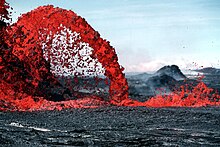
Earthquakes and volcanoes

Earthquakes
An earthquake, earthquake or earthquake also called (from the Greek "σεισμός" tremor) or tierra1 tremor is a shaking of the ground produced by the collision of tectonic plates and the release of energy in the course of a sudden reorganization of materials Earth's crust to overcome the state of mechanical equilibrium. The most important and frequently occur when releasing stored elastic potential energy in the gradual deformation of the rocks adjacent to an active fault plane, but can also occur from other causes, such processes around volcanic or karst cavities collapse.


Volcanoes
A volcano (the mythological god Vulcan) is a tube placed in direct communication the top of the solid crust with lower levels of it. It is also a geological structure which emerge from the magma (molten rock) as lava and gases from the interior. The rise usually occurs in episodes of violent activity called "rash", which can vary in intensity, duration and frequency, being from conduit lava flows extremely destructive to explosions.
Generally acquire a characteristic conical shape is formed by magma pressure and the accumulation of material from previous eruptions. Can be found above the volcano whose crater or caldera.
Volcanoes can be found on Earth and other planets and satellites, some of which are made of materials that we consider "cool" these are the cryovolcanoes. That is, they rock acts as the ice cold water while the internal liquid acts as the magma, that happens, for example in the cold Jupiter's moon Europa.
Usually, the volcanoes are formed at the boundaries of tectonic plates, although there are exceptions called hot spots or hot spots located in the interior of tectonic plates, such as the Hawaiian Islands. There are also underwater volcanoes that can remove enough material to form volcanic islands.
Geologists have classified into three categories volcanoes: shield volcanoes, cinder cones and composite cones (also called stratovolcanoes)